Black Silhouette of Bulls in Water
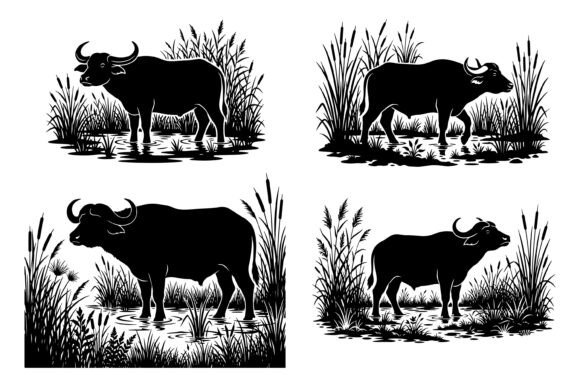
A set of four black silhouettes of bulls standing in water with grass isn’t just a simple illustration—it’s a quietly powerful visual motif. Its monochrome palette, grounded composition, and iconic minimalism make it unusually versatile: instantly legible at small sizes, emotionally resonant without relying on detail, and adaptable across contexts where clarity, tone, and intention matter more than ornamentation.
Why This Design Works So Well
The strength lies in restraint. Each bull is reduced to its essential outline—no texture, no shading, no facial expression—yet the posture, spacing, and relationship to water and grass imply stillness, resilience, and quiet presence. The water line creates horizontal rhythm; the grass adds subtle organic contrast without breaking the monochrome rule. Because it’s not literal or narrative-driven, it avoids cultural or temporal specificity—making it feel both timeless and open to interpretation.
This isn’t abstraction for its own sake. It’s functional minimalism: every element serves balance, scale, or meaning. Designers reach for it when they need symbolism without cliché—strength without aggression, nature without sentimentality, unity without uniformity.
Creative Applications Across Mediums
Unlike trend-dependent visuals, this motif thrives in real-world use cases because it scales cleanly, prints reliably, and translates across formats without loss of impact.
- Branding & Identity: Small businesses in agriculture, wellness, outdoor gear, or sustainable goods use it as a subtle anchor in logos or pattern elements—especially where “natural authority” matters more than flash. A farm-to-table café might integrate one bull into a letterpress menu border; a yoga studio could animate the water line as a gentle wave in a class schedule graphic.
- Digital Interfaces: As a loading icon, section divider, or empty-state illustration, it reads clearly on mobile and dark-mode displays. Its consistent negative space makes it ideal for SVG implementation—lightweight, responsive, and accessible with proper alt text (e.g., “Four stylized bulls standing in shallow water amid grass”)
- Print & Environmental Design: On signage, packaging, or exhibition walls, the set holds up at large scale. One user printed it at 8 feet tall on matte vinyl for a livestock education exhibit—visitors consistently described it as “calm but commanding,” proving that simplicity can carry weight without volume.
- Educational Materials: Teachers use individual silhouettes to teach concepts like symmetry, silhouette drawing, or habitat layers (water, land, vegetation). A biology educator adapted the grass-water-bull layering to explain ecosystem interdependence—students sketched their own versions using local species, keeping the structure but changing content.
Adapting for Different Audiences and Goals
What makes Black Silhouette of Bulls in Water with especially useful is how easily it shifts tone based on context—not through redesign, but through placement, pairing, and purpose.
For marketers launching a premium water brand, the motif works best when isolated on crisp white or deep charcoal stock—no type needed. The silence around it becomes part of the message: purity, depth, stillness. For a nonprofit advocating for grassland conservation, the same image gains urgency when placed beside a short statistic (“70% of native prairie lost since 1950”) and paired with a call to action in clean sans-serif type.
Freelancers building portfolio sites often embed the set as a subtle background pattern behind service descriptions—repeating at low opacity so it supports rather than competes. One UX designer used it as a progress indicator in a client onboarding flow: four bulls, one highlighted per completed step. No explanation required—the visual logic was immediate.
Staying Clear, Consistent, and Original
Because the motif is simple, it’s easy to overuse—or worse, dilute through inconsistent execution. Here’s what keeps it effective:
- Maintain the ratio: The original set uses consistent spacing between bulls and a fixed water-line height. When adapting, preserve that proportional relationship—even if resizing or recoloring (e.g., reversing to white-on-black for apparel prints).
- Respect the monochrome boundary: Adding even a single accent color—like green grass or blue water—breaks the visual contract. If color is essential, start fresh with a new concept. This motif earns trust by keeping its promise: clarity through constraint.
- Anchor it with purpose: Don’t drop it in because it “looks nice.” Ask: Does it reinforce a value? Clarify a relationship? Signal continuity? One publisher used it across chapter openings in a book about rural entrepreneurship—the repeated image became a quiet throughline, signaling grounded, deliberate growth.
Ideas to Try This Week
You don’t need to launch a campaign to test its usefulness. Start small:
- Replace a generic stock divider in your next presentation slide with a single bull silhouette—centered, sized to 10% of slide height. Notice how it focuses attention better than a line or icon.
- Sketch the set from memory—not to replicate it, but to internalize its proportions. Then redraw one bull interacting with a local landscape (e.g., desert sage, urban curb, riverbank). You’ll see how much expressive range lives in the shape alone.
- Use it as a prompt in a team workshop: “What does ‘standing in water’ mean for your project right now?” Let the image spark grounded conversation—not about bulls, but about stability, reflection, or transition.
Black Silhouette of Bulls in Water with endures not because it’s mysterious, but because it’s honest: no hidden layers, no forced metaphor, just form serving function. That kind of clarity is rare—and increasingly valuable—for anyone making things that need to be seen, understood, and remembered.