Black and White Lake Scenes with Silhouette
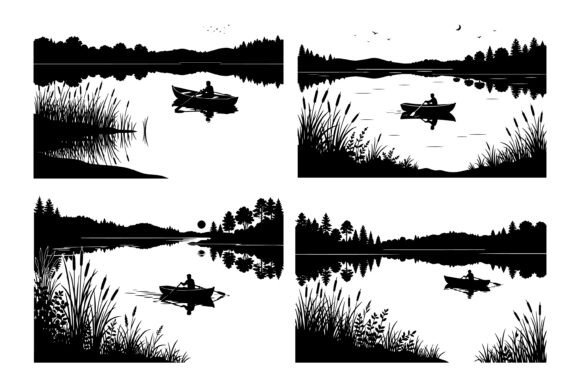
Black and white lake scenes with silhouette aren’t just quiet pictures—they’re versatile visual tools that resonate across design, wellness, education, and personal expression. At their core, they’re minimalist yet evocative: four carefully composed illustrations of serene lakes where still water mirrors reeds, distant trees, and soft horizons—each anchored by a single human figure in a boat, reduced to a gentle, anonymous silhouette. The absence of color shifts attention to form, contrast, rhythm, and mood—making them unusually adaptable for real-life applications.
Where These Scenes Fit Naturally Into Daily Life
Think of them less as “art for art’s sake” and more as quiet collaborators. A graphic designer building a mindfulness app interface might use one of these lake scenes as a subtle background for a breathing exercise screen—its monochrome tone avoids visual fatigue, while the silhouette invites users to project themselves into the moment. Similarly, therapists sometimes print and frame one of the images in waiting rooms; clients consistently report feeling calmer, not because the image “does” something, but because its stillness acts as an unspoken cue—a visual pause button amid daily noise.
In interior design, these illustrations work especially well in spaces meant for reflection or transition: home offices, library nooks, hospital corridors, or even yoga studio lobbies. Unlike busy color photography or abstract patterns, black and white lake scenes with silhouette hold space without demanding attention. One architect shared how she used all four images as a repeating motif in a wellness center’s hallway—varying only scale and placement—to create a slow, rhythmic visual journey that guests unconsciously follow as they walk.
Practical Uses Across Different Audiences
Educators and curriculum designers find value in the simplicity of the compositions. A high school literature teacher uses the third scene—where reeds bend gently at the water’s edge—as a prompt for descriptive writing. Students don’t get overwhelmed by detail; instead, they focus on texture (“crisp reed lines against soft water”), contrast (“the dense tree mass versus the open sky”), and implied narrative (“Who is in the boat? Where are they going?”). It’s a low-barrier entry point into visual literacy and metaphor.
Content creators and small business owners rely on these illustrations for consistent, copyright-safe visuals. A podcast host focusing on mental wellness licenses the set for episode thumbnails—each week pairing a different lake scene with a relevant quote overlay. Because the base image remains calm and neutral, the message stays centered, not distracted. Likewise, a journal publisher uses them as chapter dividers in guided reflection workbooks: no need to explain the image, just let it breathe between prompts.
Print-on-demand artists and stationery makers appreciate how cleanly these convert to physical products. The strong tonal range ensures crisp reproduction on everything from matte fine-art prints to textured linen notebooks—even when scaled down to a 3×4 inch greeting card. One maker noted that customers often buy multiple scenes together, not for variety’s sake, but to create intentional sequences: “morning light,” “midday stillness,” “golden hour,” and “twilight departure”—even though none of the originals name a time of day. The silhouettes make that interpretation possible.
What to Consider Before Choosing or Using Them
Because they’re intentionally minimal, black and white lake scenes with silhouette won’t suit every context. If your goal is energetic branding—say, for a sports apparel line or a children’s learning app—they may feel too restrained. They thrive where subtlety supports the purpose, not competes with it. Also, keep in mind that the person in the boat is deliberately anonymous and gender-neutral: this is a strength for inclusive communication, but could be a limitation if your project requires specific representation (e.g., cultural attire, visible age markers, or activity-based identity).
Another practical note: lighting matters. These illustrations rely on clear tonal separation—deep blacks, true whites, and rich mid-grays. On lower-resolution screens or poorly calibrated monitors, subtle gradients in the water reflections can flatten, making the scene feel flatter than intended. For digital use, test them across devices—or consider a version with slightly heightened contrast if distribution includes older tablets or projected slides.
And while the set includes four distinct compositions, they share a cohesive visual language: consistent horizon placement, similar reed density, and comparable silhouette scale. That harmony is intentional—it lets users build continuity across projects without needing custom edits. But if you need dramatic variation (e.g., stormy water, winter ice, or mountain backdrops), this collection isn’t built for that scope. Its power lies in restraint, not range.
Why Simplicity Works—Without Feeling Sparse
It’s easy to assume “black and white” means “basic.” But these lake scenes carry layered functionality. The reeds aren’t just decorative—they create vertical rhythm and gentle framing. The trees aren’t generic—they recede with believable depth, thanks to careful gradation in the foliage mass. Even the boat’s shape is chosen for quiet balance: wide enough to read as stable, narrow enough to suggest movement or pause, depending on how the viewer leans in.
That nuance makes them resilient across mediums. A meditation app developer told us she tried swapping in color versions—and users reported higher cognitive load during sessions. “The color pulled attention *away* from their breath,” she said. “The black and white version didn’t ask for interpretation. It just held space.” That’s not passive design—it’s precision.
For individuals building personal rituals—like morning coffee with intention or end-of-day reflection—the scenes serve as gentle anchors. One writer keeps the second illustration (with trees reflected sharply, water perfectly still) taped beside her desk. “It doesn’t shout ‘be calm,’” she explained. “It just *is* calm—and that makes calm feel possible, not like a task.”
Getting the Most Out of the Collection
If you’re selecting one or more for a project, start by asking: What emotion or action do I want to support—not depict? Calm isn’t shown; it’s invited. Focus isn’t enforced; it’s made easier. Rest isn’t illustrated; it’s quietly modeled.
Don’t overlook sequencing. Even though each image stands alone, arranging them in order—from widest horizon to most intimate shoreline—creates a subtle narrative arc. Some users print them as a mini-series for therapy walls or classroom corners, labeling them only with numbers or single words: “Arrive,” “Breathe,” “Listen,” “Release.” No explanation needed. The visuals do the grounding.
And remember: their strength isn’t in what they include, but in what they leave out. No weather drama. No facial expressions. No brand logos or timestamps. That emptiness isn’t absence—it’s invitation. Space for the viewer to arrive exactly as they are.