Chef Hat Whisk Bowl Kitchen Icon SVG
If you’ve ever stared at a blank tumbler, an empty tote bag, or a bare wall in your kitchen and thought, “I wish I had just the right design to make this feel *mine*,” then the Chef Hat Whisk Bowl Kitchen Icon SVG is exactly what you’ve been looking for—not as a generic clipart placeholder, but as a precise, versatile, and thoughtfully built digital asset that works where you need it most.
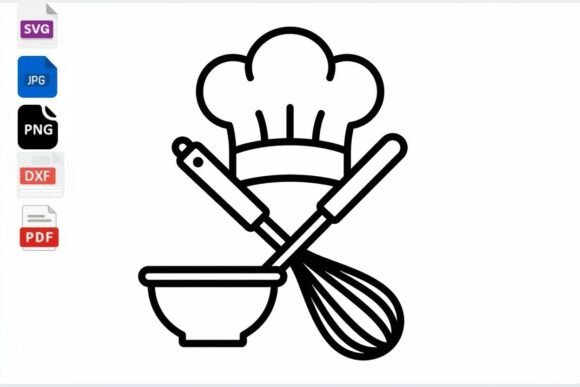
This isn’t just another kitchen-themed graphic. It’s a clean, balanced silhouette—chef hat, whisk, and mixing bowl arranged in harmony—that communicates culinary passion, professionalism, or playful foodie energy in one glance. Designed with vector precision, it scales without blur, cuts cleanly on vinyl, prints crisply on fabric, and imports smoothly into design software you already use.
Where This SVG Fits Into Real Creative Workflows
Let’s talk about where people actually use it—not in theory, but in practice.
- A small-batch baker orders custom aprons for her weekend farmers’ market stall. She drops the Chef Hat Whisk Bowl Kitchen Icon SVG into Silhouette Studio, adjusts spacing, and cuts heat-transfer vinyl in sage green. Customers recognize the icon instantly—it feels handmade, not mass-produced—and she reuses the same file for Instagram story highlights and her Etsy shop banner.
- A middle school home economics teacher prints the PNG version (with transparent background) onto sticker paper, laminates it, and uses it as a reusable station label: “Mixing Station,” “Baking Tools,” “Safety Zone.” Students grab the right tools faster—and the visual consistency reduces classroom confusion.
- A freelance food photographer adds the SVG as a subtle watermark in the corner of her portfolio PDFs. Because it’s in AI format, she tweaks the stroke weight and color to match each client’s brand palette—no extra design time, no licensing headaches.
Why Format Variety Matters More Than You Think
You don’t always know which format you’ll need until you’re mid-project. That’s why this set includes SVG, EPS, JPG, PNG, PDF, and AI files—not as marketing filler, but as practical insurance.
The SVG works instantly in Cricut Design Space and Silhouette Studio Designer Edition—no tracing, no grouping issues, no layers collapsing. If you’re cutting vinyl for a coffee shop’s window decal, that reliability saves 20 minutes of troubleshooting.
The EPS and AI files let you edit anchor points, recolor individual elements (say, making the whisk gold while keeping the bowl charcoal), or combine it with typography in a logo mockup. A café owner building her own menu board in Illustrator doesn’t need to hire a designer just to swap colors.
The PNG with transparent background is what you reach for when you’re uploading to Canva for social posts, adding to a PowerPoint training deck for new kitchen staff, or dropping into a Google Slides lesson on kitchen safety. No white boxes. No awkward cropping.
And the PDF? That’s for the educator printing flashcards, the parent organizing a kids’ cooking camp, or the event planner designing place cards for a culinary workshop—no software required, just print and go.
Real Use Cases Across Everyday Roles
Hobbyists often start with simple projects—like personalizing a stainless steel tumbler for their morning coffee ritual. The Chef Hat Whisk Bowl Kitchen Icon SVG cuts cleanly on permanent vinyl, sticks well to curved surfaces, and resists fading after hand-washing. It’s not flashy—but it makes the mug feel intentional.
Small business owners use it to unify branding across touchpoints: same icon on aprons, receipts, and the “About Us” page of their website. Consistency builds trust, and because the SVG is lightweight and web-ready, it loads fast—even on mobile.
Bloggers and content creators embed the PNG version into recipe roundups (“5 Must-Have Kitchen Icons for Food Bloggers”) or use the AI file to build branded Pinterest pins. One creator told us she reused the same icon—slightly resized and recolored—as both a blog sidebar widget and a downloadable checklist cover (“Your First 10 Kitchen Essentials”).
Educators and trainers rely on its clarity. Unlike busy illustrated icons, this silhouette reads clearly even at ¾-inch tall on a laminated tool card. A culinary instructor at a community college uses it to label knife rolls, oven mitt hooks, and pantry bins—students learn faster when visual cues are consistent and uncluttered.
What to Consider Before You Use It
Not every project needs every format—but knowing which one fits your tool and goal keeps things moving:
- If you’re using a Cricut Explore or Maker, stick with the SVG. It imports cleanly and respects layer groupings—so you can cut the hat, whisk, and bowl separately if needed (e.g., for multi-color iron-on).
- If you’re editing in Adobe Illustrator and plan to scale it beyond poster size—or combine it with custom type—use the AI or EPS. These retain full editability and embed cleanly in print-ready PDFs.
- If you’re sharing with someone who doesn’t have design software (a printer, a volunteer, a student), send the PNG or PDF. They’ll open it without installing anything—and won’t accidentally distort the vector paths.
- Don’t assume transparency = automatic cut-line readiness. For vinyl cutting, double-check that your software recognizes the outline as a single path—not separate shapes. Most versions here are pre-optimized, but a quick “Ungroup → Attach” in Silhouette Studio takes two seconds.
Also: think about context. That same icon looks warm and inviting on a bakery’s chalkboard sign—but might feel too casual on a corporate catering company’s investor pitch deck. It’s flexible, not universal. Pair it intentionally.
More Than Just an Icon—It’s a Starting Point
The Chef Hat Whisk Bowl Kitchen Icon SVG doesn’t replace your voice, your process, or your expertise. It supports them. It’s the quiet helper behind the apron tag, the clean accent on a recipe card, the recognizable marker on a kitchen supply shelf. It’s designed so you spend less time wrestling with files and more time doing the work you care about—teaching, baking, designing, selling, creating.
Whether you’re labeling a child’s first baking kit, launching a meal-prep subscription, or refreshing your café’s interior signage—the icon adapts without demanding attention. It’s clear. It’s capable. And it’s ready when you are.