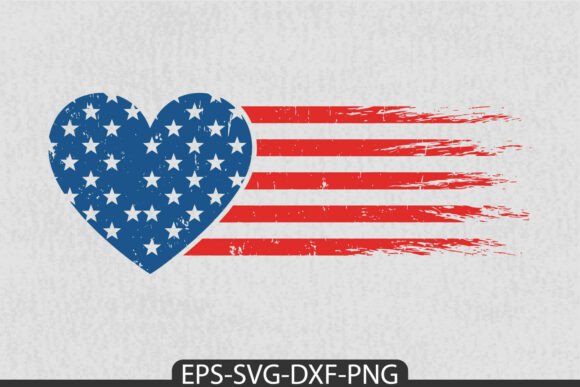
Distressed American Flag Heart SVG
If you're looking to add patriotic charm with authentic texture and emotional resonance—especially for Independence Day, Veterans Day, Memorial Day, or everyday American pride—a Distressed American Flag Heart SVG is a smart creative choice. Unlike flat, glossy vector hearts, this design combines symbolic meaning (the heart) with layered visual storytelling (the weathered, frayed, slightly faded flag). It’s not just decoration—it’s intentional visual communication: reverence, resilience, history, and heartfelt connection, all in one scalable file.
Why This Design Stands Out—And Why That Matters
The “distressed” effect isn’t just aesthetic flair—it signals authenticity. Real flags flutter, fade, fray, and bear the marks of time and use. A well-executed Distressed American Flag Heart SVG captures that honesty without sacrificing clarity or scalability. That’s essential whether you’re cutting vinyl for a t-shirt, layering it into a social media graphic, or embroidering it onto a tote bag. The distressing must be subtle enough to retain legibility at small sizes—and rich enough to hold character at large scales.
But here’s where many buyers stumble: assuming *any* “distressed flag heart” SVG will work across tools and materials. That’s rarely true. Not all files are built with clean paths, consistent stroke weights, or compatible layer structures. And not all sellers test their designs across platforms like Cricut Design Space, Silhouette Studio, Adobe Illustrator, or Canva.
Common Oversights—And What They Cost You
Assuming “SVG” means universal compatibility. An SVG file may open in your browser—but that doesn’t mean it’ll cut cleanly on your machine. Some versions embed raster images (like PNG textures) inside the SVG, which break when resized or imported into cutting software. Others use unsupported filters or gradients that vanish or distort in certain editors. The result? A heart that looks perfect on screen but fails to cut, prints with jagged edges, or loses its distressed detail at 2 inches wide.
Overlooking file organization. You’ll receive a ZIP folder containing EPS, SVG, PNG, and DXF formats—but if layers aren’t named clearly (e.g., “Flag-Background,” “Heart-Outline,” “Distress-Overlay”), editing becomes guesswork. Beginners often merge layers unintentionally, flattening texture and making color changes impossible. Professionals waste minutes—or hours—reconstructing what should’ve been intuitive.
Misjudging resolution needs for different uses. A high-DPI PNG is great for web banners or digital presentations—but useless for vinyl cutting. Conversely, an unoptimized SVG with excessive anchor points slows down your cutting software and increases error risk. One user reported repeated “tool path failed” alerts until they realized their SVG included invisible duplicate shapes beneath the main heart—something the seller hadn’t mentioned or cleaned.
What to Check Before You Download—or Buy
Before hitting “purchase” or extracting that ZIP folder, verify these three things:
- Preview the SVG in a plain text editor (like VS Code or Notepad++). Look for embedded
filterreferences—if present, the file likely won’t scale cleanly or cut reliably. - Open the EPS in Illustrator and check the Layers panel. Are elements grouped logically? Is the distress effect applied as a clipping mask or overlay—not baked into the flag shape? That distinction determines whether you can recolor the heart red/white/blue independently or adjust texture opacity later.
- Test the DXF in your cutting software at actual size. Zoom in on edges: do lines connect smoothly? Are there stray nodes or tiny floating segments? These cause hesitation, double-cutting, or incomplete cuts—especially on curved distress details.
Better Choices Start With Smarter Habits
Choose files labeled “cut-ready” or “craft-tested”—not just “high-res” or “commercial use.” Those terms tell you the creator understands real-world constraints. One small business owner switched from a $3 marketplace SVG to a $7 version explicitly tagged “Cricut & Silhouette Verified”—and cut her prep time per project from 20 minutes to under 90 seconds. The difference? Clean outlines, no hidden layers, and pre-separated colors for multi-material projects (e.g., white heart + red distress overlay).
Also, don’t skip the PNG—but use it purposefully. Its value isn’t in cutting; it’s in quick mockups, blog headers, or email newsletter graphics where vector precision isn’t needed, but fast, consistent rendering is. Save the SVG and DXF for physical production, and lean on the EPS only if you’re sending artwork to a professional printer who requests it.
A Note on Licensing—and Why It’s Practical, Not Just Legal
Licensing isn’t about restriction—it’s about sustainability. A properly licensed Distressed American Flag Heart SVG lets you confidently use it on merchandise you sell (t-shirts, mugs, patches), in client work (with clear attribution or extended license), or in educational materials (classroom handouts, workshop slides). But “personal use only” files? They’re fine for your own porch banner—but become a liability if you print 50 for a local fundraiser and someone asks for a copy. Always confirm license scope *before* designing your layout. Rebuilding around a new file mid-project wastes time and disrupts deadlines.
One Last Practical Tip: Resize Thoughtfully
Distressing works best within a range. Below 1.5 inches wide, fine texture blurs or disappears. Above 24 inches, overly aggressive distressing can look muddy unless the original was built with high-fidelity vector grain (not raster noise). If you need both tiny and huge versions, ask the seller if they offer alternate versions—or plan to simplify the distress manually in Illustrator using the Appearance panel (add subtle inner glow + grain effect, then expand). It takes five minutes and gives you full control.
Ultimately, a Distressed American Flag Heart SVG is more than a download—it’s a tool. And like any good tool, its value multiplies when you understand its limits, respect its structure, and match it to your real workflow—not just your initial inspiration.