Hiking Silhouettes Walking Uphill with T: A Strategic Visual Asset for Purposeful Communication
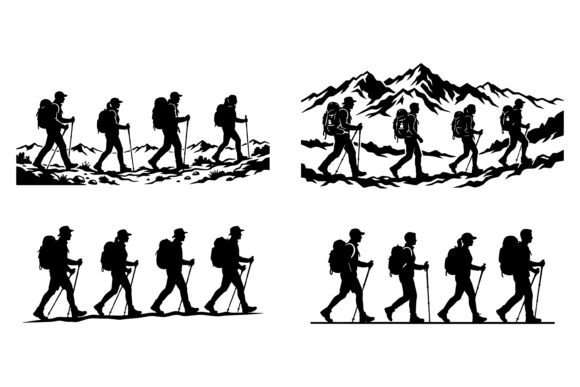
Visual assets carry weight—not just aesthetic weight, but strategic weight. Hiking Silhouettes Walking Uphill with T is more than a set of black vector figures climbing a slope with trekking poles. It’s a distilled visual metaphor: effort, direction, progression, support, and terrain awareness—all rendered in clean, scalable, background-agnostic forms. For professionals who rely on clarity, consistency, and intentionality in communication—whether designing a workshop slide, illustrating a growth framework, or building a brand narrative—this asset offers precision where generic stock imagery falls short.
Why This Set Fits Real-World Decision-Making
Unlike abstract icons or overused “team climbing mountain” photos, Hiking Silhouettes Walking Uphill with T delivers controlled variation without ambiguity. You get multiple walking positions—some upright, some leaning forward, some pausing—each with or without trekking poles, and each usable with or without a mountain backdrop. That flexibility isn’t decorative; it’s functional. It supports decisions about pacing, role differentiation, and stage-based storytelling. A marketer mapping a customer journey might use the “paused” silhouette to signal reflection before a purchase decision. An educator illustrating resilience might pair the “leaning forward” figure with a caption about sustained effort—not inspiration, but applied momentum.
This set works because it avoids emotional coercion. There’s no smiling, no sunset, no forced triumph. It communicates process—not outcome. That neutrality makes it adaptable across contexts where authenticity matters: internal strategy decks, compliance training visuals, nonprofit impact reports, or SaaS onboarding flows. When your goal is to represent progress without implying inevitability—or to show support (via trekking poles) without oversimplifying interdependence—you’re not selecting clip art. You’re selecting a tool for calibrated meaning.
Strategic Use Cases Across Roles
Different roles engage with Hiking Silhouettes Walking Uphill with T in different ways—not as decoration, but as scaffolding:
- Product managers use the varied postures to map user behavior stages: initial engagement (upright), friction points (slight lean), recovery (pole-supported stance), and milestone achievement (forward-focused stride). The absence of facial expression keeps attention on action—not emotion.
- Freelancers and consultants embed these silhouettes into proposal diagrams to visualize client capacity-building—not “we’ll fix everything,” but “here’s how your team gains footing, step by step.” The trekking poles become quiet symbols of scaffolding, not crutches.
- Educators and trainers layer them onto timelines or competency ladders. Because the silhouettes scale cleanly and sit crisply against light or dark backgrounds, they integrate seamlessly into PDF handouts, LMS modules, or printed facilitator guides—no pixelation, no licensing friction.
- Small business owners apply them in service packaging: a three-tiered offering might pair “single hiker” (foundational), “two hikers, one with pole” (collaborative support), and “group ascending” (full implementation)—all using consistent visual grammar.
Planning Your Use—Not Just Placing It
Intentional use starts before opening the file. Ask: What decision does this visual need to support? If the answer is “make the slide look busy,” pause. If it’s “clarify that progress requires both individual motion and external tools,” then Hiking Silhouettes Walking Uphill with T earns its place.
Consider contrast and context. These silhouettes gain strength when paired with restrained typography and ample whitespace—not competing illustrations or gradient overlays. Their power lies in subtraction: removing distraction so the viewer focuses on posture, direction, and relationship between figures. When used in a dashboard showing team development metrics, for example, pairing a “two hikers, one with pole” image beside a “72% increase in cross-functional mentoring” stat creates grounded resonance—not vague aspiration.
Also consider timing. These silhouettes communicate *ongoing* effort—not arrival. They’re poorly suited for “mission accomplished” announcements or celebratory banners. But they’re exceptionally well-suited for roadmaps, quarterly planning documents, change management comms, or learning pathway maps—where honesty about duration and support is part of credibility.
Risks of Context-Free Deployment
Like any strong visual shorthand, Hiking Silhouettes Walking Uphill with T can misfire when decoupled from purpose. Using it repeatedly across unrelated materials—say, in a cybersecurity whitepaper, a payroll software demo, and a yoga studio newsletter—dilutes its semantic weight. Overuse without variation (e.g., always the same upright hiker, always on a mountain) turns metaphor into cliché. Worse, applying it to contexts where “uphill” implies negative struggle—like burnout recovery or crisis response—can unintentionally reinforce harmful narratives about constant exertion.
Another risk: assuming universality. While the silhouette form is culturally legible across many professional settings, its interpretation shifts subtly. In some organizational cultures, “uphill” reads as challenge to be overcome; in others, it signals unsustainable pressure. Ground your choice in audience awareness—not just visual appeal. Test it: show the image to two colleagues unfamiliar with the project and ask, “What does this say about the work happening here?” Their answers will reveal whether the metaphor aligns—or obscures.
Long-Term Value Lies in Consistency, Not Quantity
The highest ROI from Hiking Silhouettes Walking Uphill with T comes not from using all 12 variations at once—but from selecting 2–3 postures and applying them with discipline across a 6- to 12-month initiative. A leadership development program might adopt the “hiker with pole, mid-stride” as its signature visual—appearing in emails, cohort workbooks, and facilitator scripts. That repetition builds recognition and cognitive ease. Viewers begin to associate that specific posture with a shared understanding: “This is how we describe supported, forward motion in our work.”
That kind of consistency supports long-term results in two concrete ways: First, it reduces cognitive load for your audience—they spend less energy interpreting visuals and more on applying insights. Second, it strengthens internal alignment. When teams use the same visual language to describe progress, they’re more likely to calibrate expectations, identify bottlenecks early, and adjust support mechanisms—not because a chart says so, but because their shared mental model has been reinforced visually and repeatedly.
How to Approach Selection—A Practical Filter
Before inserting a silhouette, run it through this brief filter:
- Does it reflect actual movement in the process I’m describing? (e.g., Is this phase about steady pacing—or sudden acceleration? Choose accordingly.)
- Does the presence or absence of trekking poles match the level of support available or required? (A solo founder bootstrapping a product launch may need the “pole” version far more than a large team with dedicated resources.)
- Does the background choice serve clarity—or clutter? (Mountain backdrop adds context but limits versatility; no background maximizes reuse across formats and platforms.)
- Will this image still make sense six months from now—or does it tie too tightly to a momentary trend?
If the answer to all four is grounded and affirmative, you’re not just adding an image. You’re reinforcing a decision-making habit: choosing tools that mirror reality, not idealized versions of it.
Final Thought: Visual Assets as Extensions of Judgment
Hiking Silhouettes Walking Uphill with T doesn’t replace strategy—it reveals it. How you choose to depict effort, support, and direction tells your audience what you value, what you assume, and how rigorously you’ve considered the human dimensions of progress. Used thoughtfully, it becomes part of your operational vocabulary: precise, reusable, and quietly persuasive. Used carelessly, it fades into noise—another unexamined element in a crowded digital landscape.
So treat it like any other high-leverage tool: assess fit before adoption, prioritize clarity over novelty, and revisit usage regularly—not to chase trends, but to ensure your visuals continue serving the decisions that matter most.